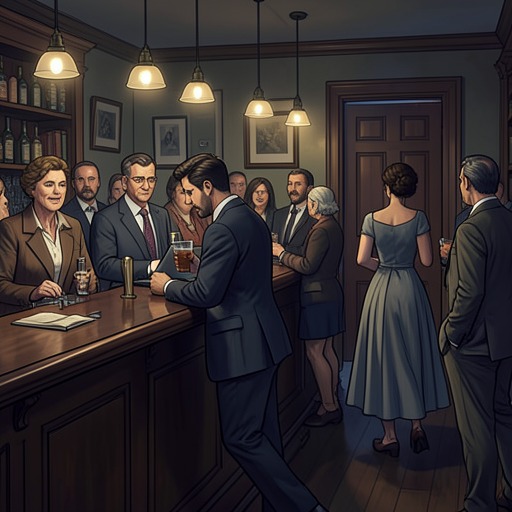
Ford Turner
Hayden's TimbreFord Turner is the manager of The Bar and one of the first people to give Timbre Simons a practical foothold after unemployment and housing insecurity have narrowed her choices. He hires her as a cocktail waitress, places her in a workplace shaped by male customers’ scrutiny, and insists that staff harassment will not be tolerated. Through Ford, the bar becomes more than a temporary source of wages: it is a testing ground in which Timbre learns to negotiate presentation, exhaustion, money, boundaries, and the possibility of moving into better work.
Identity and Introduction
Ford introduces himself to Timbre as the manager during her application for a job at The Bar. He questions her about experience in waitressing, bartending, barbacking, dishwashing, and food handling, learning that she has worked in a restaurant and has handled food, bussing, and dishwashing but has never worked in a bar. His interview is not entirely comfortable: he looks her over and stares at her breasts, making her self-conscious and uneasy. The imbalance between his authority and her financial need is therefore present from the beginning, even though the interview leads to employment.
Ford explains that he needs another cocktail waitress because the previous waitress who worked with Jenna has quit. The job becomes fast-paced during the evening, particularly on Friday and Saturday nights when a band plays. He tells Timbre that she must wear shorts and a tight bar T-shirt, adding that she can alter the shirt and that showing more skin will probably produce better tips. This requirement makes the labor of the bar explicitly bodily and commercial: Timbre is paid not only for carrying orders but also for managing an appearance designed to attract customers. She recognizes that the work is not a career choice, yet bills make the immediate income decisive.
Management of the Bar
Ford gives Timbre a conditional opportunity rather than an unconditional promise. He tells her to complete the paperwork, come in around five, and work alongside Jenna; if the evening goes well, the job will be hers. His expectations are plain: arrive on time, do the job, and do not quit after a week or two. For Timbre, the arrangement changes the immediate future because it means she can have money in her pocket the next morning. Ford’s hiring decision thus carries material consequences disproportionate to the briefness of the interview.
The first shift exposes the difference between the imagined and actual demands of the job. Timbre expects a Tuesday night to be busier, but the room is initially sparse, and she cannot understand why Ford has asked her to come in when Jenna could apparently handle the customers alone. Ford notices her uncertainty from behind the bar and calls her out of her lost, passive stance. Later, when the crowd increases, he directs her to wait on customers and leave a particular group alone while Jenna covers that area. Timbre follows the instruction, takes orders, delivers them, and works through a steady stream of patrons until last call.
The physical cost of the shift is immediate. By the time Ford rings the last-call bell, Timbre’s feet hurt intensely, and she is already planning to buy new Chucks or better shoes. She wipes down tables and throws empty containers into recycling bins, grateful that The Bar serves only nuts and pretzels rather than a larger menu that would require more food handling. Ford’s workplace therefore gives her wages, but it also claims her body, time, appearance, and emotional composure. The job’s apparent simplicity conceals a demanding combination of service labor and self-presentation.
Protection and Workplace Boundaries
Ford’s management becomes most significant when Timbre’s discomfort intersects with customer access. After members of Assured Distraction appear at the bar, Jenna explains that Timbre had been unable to form a complete sentence while looking at the band and that one of the men had spoken with her privately. Ford asks whether the encounter explains her earlier presence in the office and whether the man said anything improper. Timbre says that he only wanted to know when she had started working there, although she had refused to answer his other questions.
Ford responds that he will not tolerate anyone harassing his staff and asks Timbre to tell him if the man said anything wrong. He repeats the warning that customers will not be allowed to give her trouble. Jenna has already explained that some older male patrons may try to touch the waitresses and that Ford will intervene if anyone becomes too aggressive. The policy does not erase the sexualized conditions of the job, especially the required shorts and tight shirt, but it establishes a boundary around the workers’ bodies: customer payment does not grant unlimited access.
Ford’s conduct combines elements that do not fully resolve into a single moral type. His comments about clothing and exposed skin treat the waitress’s appearance as part of the income-producing system, while his response to harassment marks a clear limit on that system. The contrast makes him a practical, imperfect guardian of the workplace rather than a figure who transforms its gendered structure. He accepts the bar’s commercial logic but refuses to let it become an excuse for unchecked abuse.
Connections Beyond The Bar
Ford is connected to Jenna through their shared work at The Bar. Jenna brings Timbre to work in her car after Ford calls to say that he has hired her, and she warns Timbre about the wandering eyes and hands of some customers while directing her to report anyone who becomes too frisky. At the end of the first shift, Jenna sits beside Ford at the bar after finishing her cleaning, and the two laugh together, prompting Timbre to wonder whether they are romantically involved. The evidence establishes their easy familiarity and shared workplace, while leaving the exact nature of their relationship uncertain.
Ford also encounters the wider social and professional network surrounding The Bar. He recognizes the importance of Assured Distraction, is surprised that Timbre does not follow the band’s music, and takes interest in the men who have appeared with them. Later, when Hayden Devillier waits for Timbre to finish a shift, Ford offers him a beer even though the register has already been closed and suggests that he will probably see him again. The gesture is casual and businesslike, but it shows Ford treating Timbre’s personal connection as compatible with the bar’s ordinary social life rather than automatically turning it into a workplace disturbance.
Timbre’s time at The Bar ultimately leads toward 13 Recordings, where Peri Powell and Cash interview her and offer her a job immediately. Ford is not the person who conducts that interview, but the contrast between his bar and the recording company clarifies the significance of his earlier role. At The Bar, Timbre must learn the systems of tips, uniforms, customer attention, and physical endurance; at 13 Recordings, she quickly learns computer systems and begins a more structured office position with help from Johnna. Ford’s establishment is therefore a transitional workplace, not the endpoint of her recovery.
Narrative Role and Significance
Ford functions as a threshold figure in Timbre’s economic and social trajectory. He does not solve her larger crisis, and he does not remove the exploitative pressures built into cocktail-waitress work. Instead, he provides a conditional opening, enforces a limited code of conduct, and gives her the chance to earn money while she searches for a more sustainable future. His role is defined by concrete workplace decisions: hiring her when she needs immediate income, assigning her duties as the room fills, monitoring the bar’s social dangers, and defending staff members against harassment.
The character also embodies the contradictions of service employment. He expects visible femininity to increase tips, yet he insists that visibility cannot be treated as consent. He is authoritative enough to question Timbre’s readiness and correct her inactivity, but he also recognizes that the manager bears responsibility when customers cross the line. In this way, Ford’s importance lies less in a large personal arc than in the labor structure he administers. He makes the boundaries of Timbre’s first job visible, and those boundaries help measure the distance she later travels toward stability at 13 Recordings.